How it works
Five steps, all inside your organization portal.
- Your missionary fills in their W-9 once, in their own account. The tax ID is stored encrypted; you see only the last four digits until you need the full number to file.
- Open the 1099s tab and we show each missionary with a W-9 on file, plus a starting amount taken from what your organization wallet received for them, less your commission.
- Change the amount to what you actually paid them, confirm they were paid as an independent contractor, and save the form.
- Deliver it: the missionary gets an email and a printable Copy B in their account. If they asked for paper, you print and mail their copy.
- File it with the IRS — for now you file yourself (for example in the IRS’s free IRIS portal) and mark it filed here. Use “Show full tax ID” when you file.
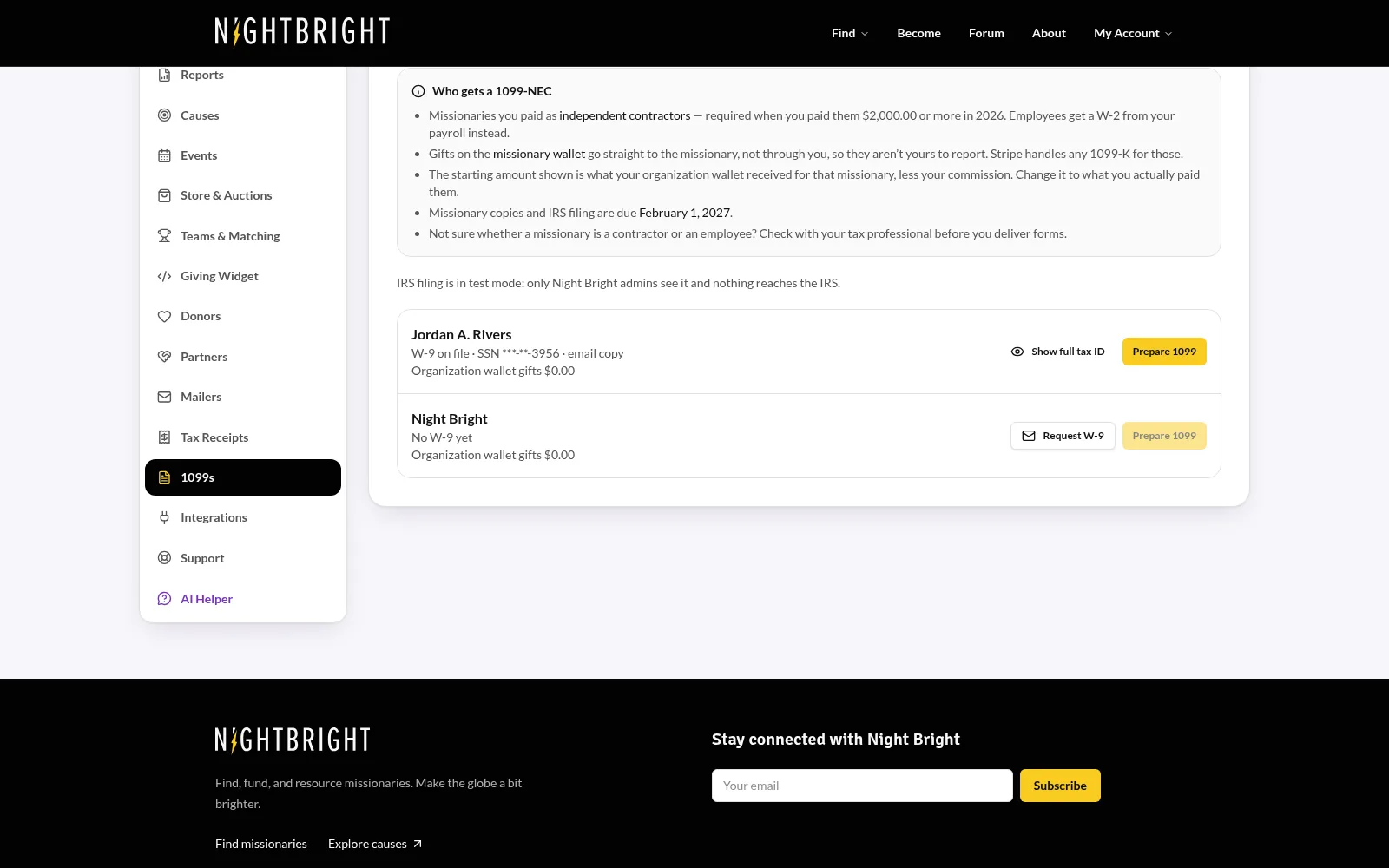
Who gets a 1099 from your organization
You are the payer, so you report what you paid.
- Missionaries you paid as independent contractors, at or above the IRS threshold for the year: $600 for payments made through 2025, $2,000 for payments made from 2026 on.
- Gifts that landed in your organization wallet and that you then paid out — that money came through you, so it is yours to report.
- People you paid for other contract work too (translation, lodging, speaking), if the total crosses the threshold.
- Employees are different: they get a W-2 from your payroll, never a 1099-NEC.
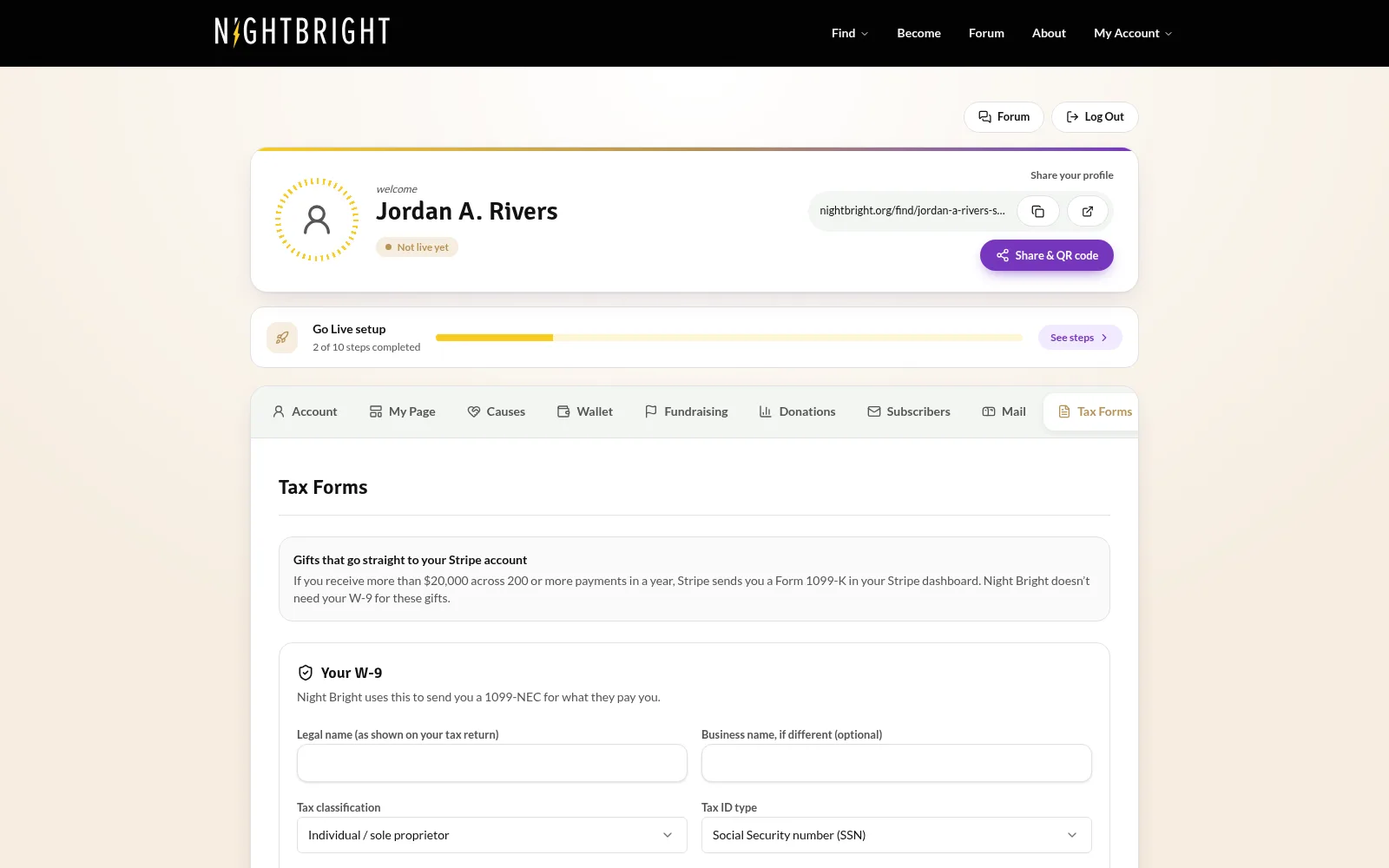
Who should expect one from Night Bright
Night Bright only reports money it paid out itself.
- Missionaries whose gifts were routed to Night Bright (homepage gifts and pages flagged as receiving gifts through the platform) are reported by Night Bright, not by your organization.
- If Night Bright’s own organization account paid a missionary, Night Bright’s team prepares and files that form.
- Donors never get a 1099 — they get a tax receipt for their gift. A 1099 is only for people who were paid.
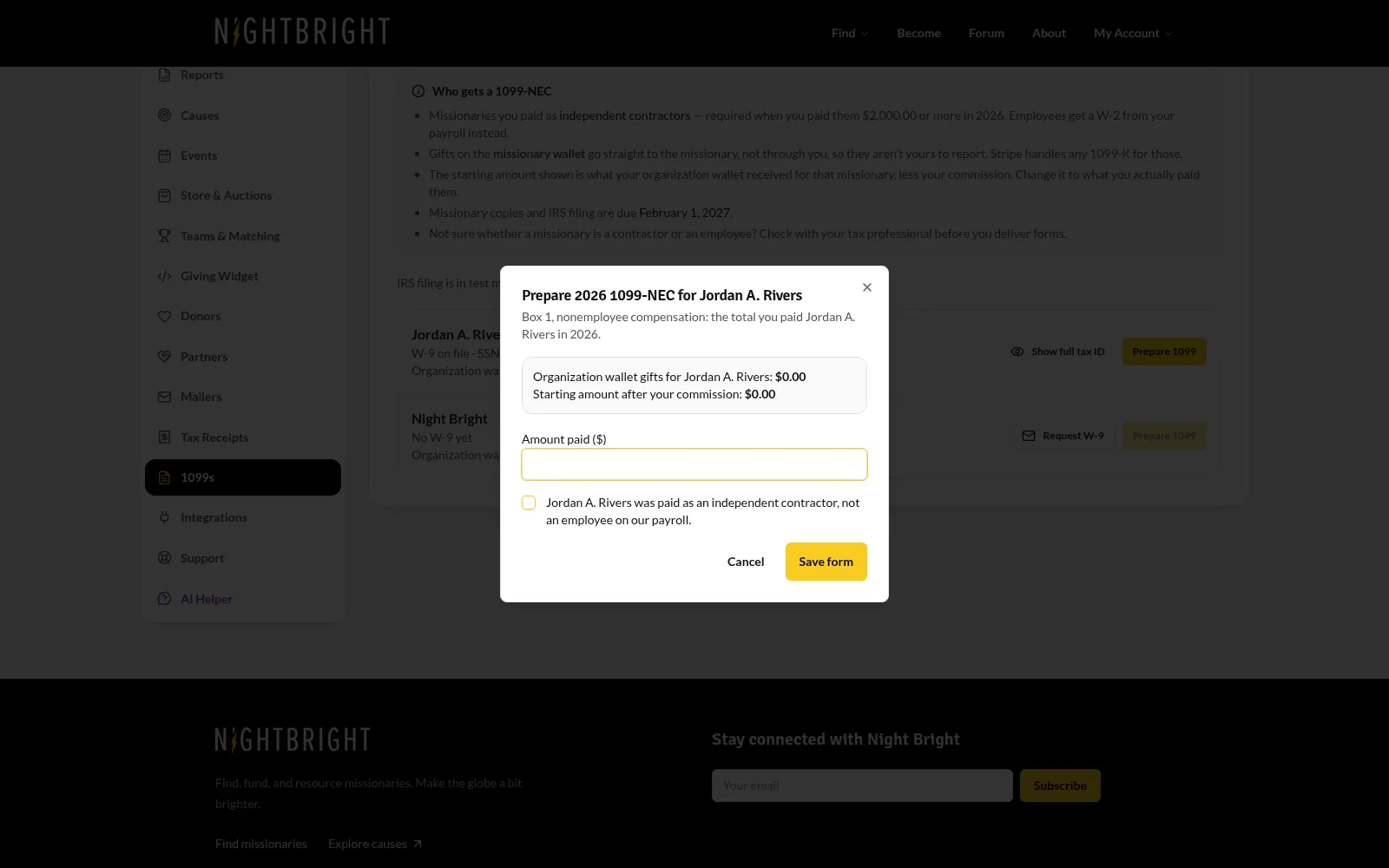
Who should file their own taxes
A 1099 is a record, not permission to wait.
- Gifts on the missionary wallet go straight to the missionary’s own Stripe account, so neither you nor Night Bright reports them. Stripe issues a Form 1099-K only if the missionary crosses its reporting threshold (currently more than $20,000 and 200 or more payments in a year).
- Below any threshold, the missionary still reports the income themselves — no form means no exemption.
- Missionaries paid by several churches or agencies collect a form from each payer; nobody combines them for you.
- Self-employment tax, deductions and quarterly payments are the missionary’s own filing, not something a 1099 decides.
Pricing
$4 per form, taken from your prepaid mail credits — the same credits you use for printed letters and postcards. Corrections are free. Filing with the IRS is included in the $4 once one-click filing is switched on; until then you file yourself and mark it filed here.
- $4 per 1099-NEC, from prepaid credits — no per-organization subscription.
- Corrections free: fix a delivered form and deliver the corrected one at no charge.
- Tax IDs encrypted at rest; every full-number view is recorded.
Important dates
Recipient copies and IRS filing for a tax year are due January 31 of the following year. Forms delivered late still have to be filed, and the IRS charges per-form penalties that grow the longer you wait — so most organizations prepare in December and deliver in the first weeks of January.
Talk to a tax professional
This page explains how Night Bright’s tool works and what the IRS rules we follow say. It is not tax advice. Contractor versus employee classification, state filing requirements, backup withholding and TIN solicitation all depend on your organization’s facts. Confirm with your own tax professional before you deliver or file forms.
Common questions
Does Night Bright file the 1099 with the IRS for us?
You can file yourself in the IRS’s free IRIS portal and mark the form filed in your portal. One-click IRS filing from inside Night Bright is being finished and will be included in the $4 per form.
What if a missionary never fills in their W-9?
You can send a W-9 request from the 1099s tab. Without a W-9 you cannot prepare the form, and backup withholding rules may apply — ask your tax professional.
Do gifts on the missionary wallet show up here?
No. Those go straight to the missionary’s own Stripe account, so they are not yours to report. Stripe handles any 1099-K for that money.
Is the $4 per form charged every year?
Only for forms you deliver. Preparing a form costs nothing until you deliver it, and corrections are free.
Still have questions?
Ask the Night Bright Helper about features, giving and pricing — or send your question to our team.
Ready to get started?
Night Bright is free for missionaries and organizations. Donors cover processing so 100% of every gift goes where it’s meant to.